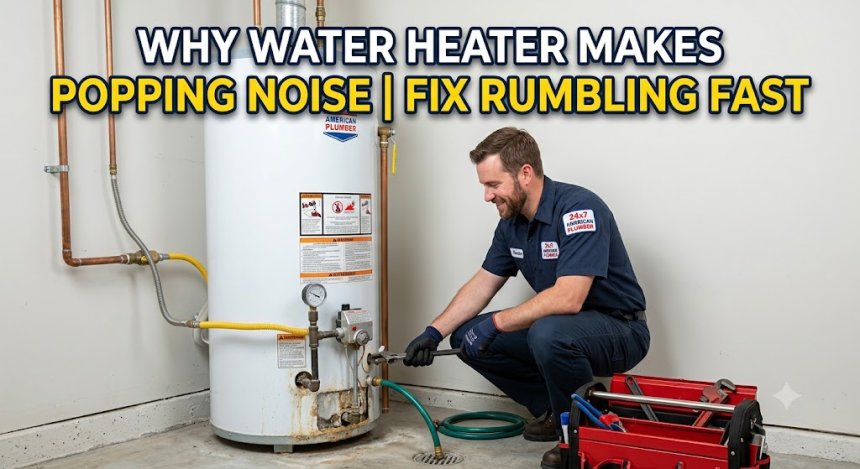
Why Water Heater Makes Popping Noise | Fix Rumbling Fast
Is your water heater popping or rumbling? Learn what causes sediment buildup, safe DIY maintenance steps, repair costs, and when to call a plumber.

Why Is My Water Heater Making a Popping or Rumbling Noise
A popping or rumbling noise from your water heater is almost always caused by heavy sediment buildup—like calcium and magnesium scale—trapped at the bottom of the tank. As water gets trapped beneath this hardened crust and boils, steam bubbles burst violently through the sediment layer, creating distinct popping, knocking, or rumbling sounds.
The Science Behind the Sound: What Is Happening Inside Your Tank?
To understand why your water heater sounds like a boiling kettle or a popcorn machine, you need to understand thermal expansion and mineral precipitation.
When hard water enters your water heater, minerals—primarily calcium carbonate and magnesium—naturally separate from the liquid as it heats. Over months and years, these minerals settle to the bottom of the tank, creating a dense, rock-like layer of mineral scale over the lower heating element (in electric units) or the burner floor (in gas units).
  +---------------------------------------------------+
  |               HOT WATER OUTLET                     |
  |                                                   |
  |             [ Water Heater Tank ]                 |
  |                                                   |
  |  Water trapped beneath scale heats past boiling   |
  |  -----------------------------------------------  |
  |  ~~~~ ~~~ ~~~ STEAM BUBBLES BURST ~~~ ~~~ ~~~~    |
  |  ===============================================  |
  |  :::: HARDENED SEDIMENT & CALCIUM SCALE LAYER :::  |
  |  ===============================================  |
  |           [ Gas Burner / Heating Element ]        |
  +---------------------------------------------------+
Here is the exact step-by-step mechanical process that generates the noise:
-
Thermal Trapping: Fresh water seeps under the thick layer of mineral scale and becomes trapped directly against the heat transfer surface.
-
Superheating & Phase Change: Because heat cannot dissipate evenly through the mineral barrier into the main water volume, the trapped water rapidly overheats past its boiling point, transforming into high-pressure steam.
-
Explosive Release: The steam pressure builds until it violently forces its way through the compacted sediment crust. As the steam bubble escapes into the cooler water above, it instantly collapses—producing the deep popping, thumping, or rumbling sound you hear.
Other Noises to Watch Out For
-
Sizzling or Hissing (Gas Units): Often indicates a water leak dripping directly onto the hot burner, or extreme condensation caused by thermal shock.
-
Ticking or Screeching: Caused by thermal expansion as uninsulated copper or PEX pipes rub against wooden wall framing, or restricted water flow through a partially closed shut-off valve.
-
Singing or High-Pitched Whistling: Signals high hydraulic pressure forcing water through a narrowed opening, such as a failing Temperature & Pressure (T&P) Relief Valve or a check valve stuck in a partially closed position.
Safe DIY vs. Professional Plumbing Services
While flushing minor sediment is a manageable weekend task for handy homeowners, handling gas lines, high-voltage electrical connections, and pressurized vessel failures requires a licensed professional.
| Diagnostic or Repair Task | Safe for DIY? | Requires Licensed Plumber |
| Visual inspection for external leaks | Yes | -- |
| Annual tank flush (light sediment) | Yes | -- |
| Testing T&P Relief Valve discharge | Yes | -- |
| Replacing lower heating elements | -- | Yes |
| Chemical/Professional descaling flush | -- | Yes |
| Replacing anode rod (corroded/seized) | -- | Yes |
| Gas control valve / Thermocouple repairs | -- | Yes |
| Tank replacement due to bottom crack/rust | -- | Yes |
If your water heater is producing persistent loud banging or you notice signs of moisture around the base, contact a professional immediately. For fast, reliable emergency plumbing and tank restoration, schedule an inspection with 24x7 American Plumber at
Step-by-Step Maintenance: How to Flush Your Tank Safely
If your tank has mild sediment accumulation and has been maintained within the last 1–2 years, a standard maintenance flush can clear out loose debris and restore quiet operation.
Safety Warning: Water inside your heater can reach temperatures well over 120°F. Wear protective eyewear, heavy-duty work gloves, and closed-toe shoes to avoid severe scalding.
Hidden Plumbing Tips Every Homeowner Should Know
-
The Plastic Drain Valve Trap: Most standard factory water heaters come equipped with cheap, plastic drain valves. Mineral sediment quickly degrades plastic threads, leading to strip-outs or permanent leaks after a single maintenance flush. Upgrading to a full-port brass ball valve provides a wider passage for heavy sediment chunks and lasts the life of the unit.
-
Sacrificial Anode Rod Protection: The anode rod attracts corrosive elements in the water so your steel tank doesn't rust. Once this magnesium or aluminum rod wears down completely (usually within 3–5 years), corrosion attacks the tank walls and hardens sediment deposits rapidly. Replacing the rod costs under $50 in parts and can double your tank's lifespan.
-
Thermal Expansion Tanks Are Mandatory: In modern closed-loop plumbing systems (equipped with backflow preventers or pressure-reducing valves), heated water expands but has nowhere to go. This spikes hydraulic pressure up to 120+ PSI, stressing tank welds, accelerating mineral compaction, and causing premature tank rupture.
What Plumbers Do: How Professionals Diagnose and Fix Noise Issues
When a DIY flush fails to eliminate popping or rumbling, the sediment has likely hardened into solid, cement-like calcification. Here is how a licensed technician from 24x7 American Plumber resolves severe cases:
-
Mechanical Descaling & Chemical Flushing: Professionals use specialized food-grade descaling agents (such as phosphoric or citric acid compounds) circulated through external transfer pumps. This breaks down thick calcium layers without corroding the inner glass lining of the tank.
-
Camera & Endoscopic Inspection: Using specialized inspection scopes inserted through the element ports, technicians inspect the internal scale density, structural integrity of the glass lining, and condition of upper and lower heating elements.
-
Hydro-Jetting & Heavy-Duty Deliming: In commercial or severe residential situations, high-pressure hydro-flushing tools break apart calcified chunks that are too large to pass through standard hose bibs.
If your water heater requires advanced descaling, element replacement, or structural diagnostic testing, leave it to the certified experts. Contact 24x7 American Plumber today at
Cost Estimates, Lifespans, and Replacement Context
When deciding whether to repair or replace a noisy water heater, consider equipment age and realistic industry costs across the United States.
| Service / Equipment Choice | Average US Cost Range | Expected Lifespan Impact |
| Standard Tank Flush & Inspection | $150 – $300 | Extends lifespan by 2–4 years |
| Anode Rod & Element Replacement | $250 – $500 | Extends lifespan by 3–5 years |
| Thermal Expansion Tank Installation | $300 – $650 | Prevents sudden high-pressure leaks |
| Tank Water Heater Replacement (50 Gal) | $1,300 – $2,800 | 8 – 12 Years |
| Tankless Water Heater Installation | $2,500 – $4,500+ | 15 – 20 Years |
The "50% Rule" for Replacement
If your traditional tank-style water heater is over 8 to 10 years old and the cost of repairs (such as replacing rusted elements, control valves, or extensive mechanical deliming) exceeds 50% of the cost of a new unit, replacement is almost always the smarter financial decision. Furthermore, if a rumbling noise is accompanied by water leaking from the bottom seam of the tank, the inner lining has cracked—a condition that cannot be repaired and requires immediate unit replacement.
When to Call the Pros
While a minor mineral pop is common in hard water areas, certain warning signs require immediate professional intervention:
-
Water pooling around the base of the water heater tank.
-
Discolored, rusty, or foul-smelling hot water coming from home fixtures.
-
The T&P Relief Valve is actively leaking or discharging steam.
-
Loud, metallic banging or knocking sound that persists after a full system flush.
-
Electrical breaker continuously trips when the unit attempts to heat water.
Don't wait for a noisy tank to turn into a catastrophic indoor flood. At 24x7 American Plumber, our master technicians are available around the clock to restore your hot water system safely and efficiently.
Contact 24x7 American Plumber Today:
-
24/7 Phone Line:
762-383-0288 -
Online Booking:
24x7americanplumber.com -
Coverage: Nationwide residential and commercial plumbing solutions.
Frequently Asked Questions
Q: Can a popping water heater explode?
A: It is extremely rare for a water heater to explode physically, as modern units feature redundant safety mechanisms like the Temperature & Pressure (T&P) Relief Valve. However, the excessive thermal stress caused by trapped boiling water can weaken the tank's internal glass lining and steel shell, leading to a major structural leak or burst pipe that floods your home.
Q: Will flushing my water heater completely fix the rumbling noise?
A: If the noise is caught early and the sediment consists of loose sand or fine scale, a standard flush will usually eliminate the sound. However, if the mineral deposits have cooked into a solid, cement-like block at the bottom of the tank, a standard flush will not dislodge it, and professional chemical descaling or tank replacement will be required.
Q: How can I prevent sediment buildup in my water heater?
A: The most effective way to prevent sediment buildup is to perform an annual tank flush and install a whole-home water softener if you live in a region with hard water. Additionally, setting your water heater temperature to 120°F (rather than higher settings) reduces the rate at which minerals precipitate out of the water.
Q: How long can I run a water heater that is making a popping sound?
A: You should address a popping water heater within a few weeks of noticing the sound. Allowing the unit to rumble for months reduces energy efficiency, raises your gas or electric bills, and subjects the bottom of the tank to extreme overheating—drastically shortening the unit's operating lifespan.