Signs of a Hidden Water Leak Inside Walls | 24x7 Plumber
Discover hidden water leaks behind drywall before costly damage occurs. Learn key warning signs, DIY tests, and when to call 24x7 American Plumber at 762-383-0288.

Signs You Have a Hidden Water Leak Inside Your Walls
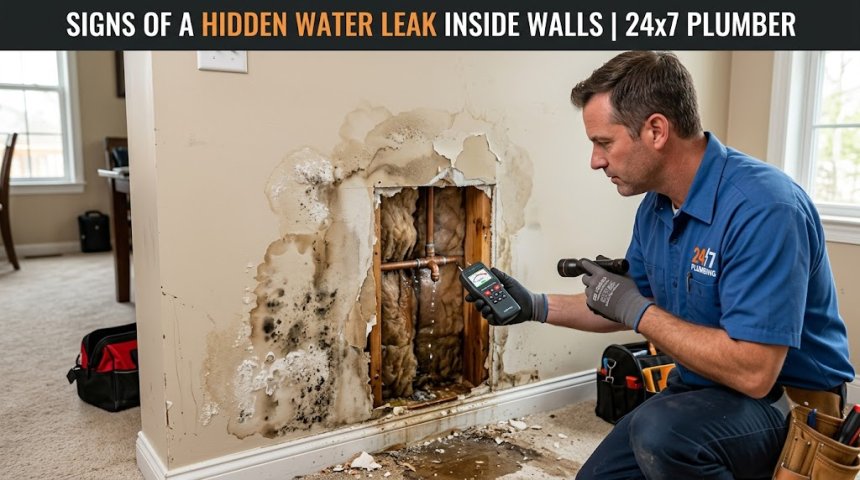
Hidden wall leaks occur when interior supply lines or drain pipes corrode, fracture, or shift, allowing water to escape continuously behind drywall. Signs include unexplained water bill spikes, musty odors, warped drywall, peeling paint, and the sound of running water when all fixtures are off.
The Physics Behind Hidden Wall Leaks: Why Pipes Leak Inside Walls
To understand why a pipe suddenly begins leaking behind a solid wall, it helps to examine the mechanical and chemical forces constantly acting on your home’s plumbing infrastructure.
                  +-----------------------------------+
                  |   Continuous Water Pressure       |
                  |     (40 - 80 PSI Baseline)        |
                  +-----------------+-----------------+
                                    |
                                    v
     +------------------------------+------------------------------+
     |                                                             |
     v                                                             v
+-----------------------+                               +-----------------------+
|  Mechanical Stress    |                               |  Chemical Reaction    |
| - Thermal Expansion   |                               | - Galvanic Corrosion  |
| - Water Hammer        |                               | - Pinhole Pitting     |
+-----------+-----------+                               +-----------+-----------+
            |                                                       |
            +-----------------------+-------------------------------+
                                    |
                                    v
                  +-----------------------------------+
                  | Structural / Drywall Saturation   |
                  |       & Mold Proliferation        |
                  +-----------------------------------+
Hydraulic Pressure & Continuous Stress
Main water lines operate under constant pressure, typically between 40 and 80 PSI (pounds per square inch). Any minor vulnerability—such as an imperfect solder joint, a loose compression fitting, or a hairline fracture in aging copper—serves as a continuous discharge point. Even a micro-pinhole leak at 60 PSI can release over 200 gallons of water per week into wall cavities.
Galvanic Corrosion
When dissimilar metals (such as galvanized steel connected directly to copper without a dielectric union) meet in the presence of water, an electrochemical reaction occurs. Electrons flow from the more anodic metal to the cathodic metal, rapidly degrading the pipe wall from the inside out until a rupture occurs.
Thermal Expansion & Contraction
Hot water supply lines expand when heated and contract as they cool. Over years of thermal cycling, copper or PEX tubing continuously rubs against wall studs, metallic straps, or floor joists. This constant abrasion eventually wears down the pipe wall, creating friction leaks.
Water Hammer & Pressure Surges
When quick-closing valves (found in washing machines, dishwashers, and solenoid-actuated faucets) abruptly halt water flow, kinetic energy travels backward through the pipe at supersonic speeds. This hydraulic shock wave, known as water hammer, reaches pressure peaks exceeding 200 PSI, weakening joints behind walls over time.
Top Warning Signs of an In-Wall Plumbing Leak
Detecting an in-wall leak before structural failure requires paying attention to subtle physical, visual, and auditory cues.
                     HIDDEN LEAK WARNING SIGNS

        Visual                   Auditory                Environmental
  +-----------------+      +------------------+     +-------------------+
  | • Blistered Paint|      | • Hissing Sounds |     | • Elevated Bills  |
  | • Warped Sheetrock|     | • Dripping Noise |     | • Musty Odors     |
  | • Discoloration |      | • Running Water  |     | • High Humidity   |
  +-----------------+      +------------------+     +-------------------+
-
Unexplained Water Bill Spikes: A sudden 15% to 30% increase in your monthly water bill without changes in daily usage usually points to a continuous supply line leak.
-
Drywall Softening, Discoloration, or Bulging: Sheetrock absorbs moisture like a sponge. Look for dark patches, soft drywall that feels spongy to the touch, or wallpaper peeling away from the plaster.
-
Paint Blistering or Bubbling: Moisture trapped behind paint forces the film away from the drywall substrate, producing visible blisters or flaking coats.
-
Musty Odors and Mold Growth: Stagnant water inside a dark wall cavity creates the ideal environment for mold spores to germinate within 24 to 48 hours.
-
Auditory Clues (Hissing or Dripping): When the home is quiet, listen near wall cavities. Continuous hissing or clicking sounds often indicate pressurized water leaking from copper or PEX supply lines.
-
Unexplained Warm Spots on Walls or Floors: A hot water line leak transfers heat through the drywall or subfloor, creating distinct warm patches that can be detected by hand or with thermal imaging.
Safe DIY Diagnostics vs. Professional Plumber Scope
Before calling in specialized equipment, homeowners can perform preliminary checks. However, knowing your limits prevents structural damage and code violations.
| Diagnostic / Repair Task | Safe for DIY Homeowners | Requires Licensed Professional |
| Water Meter Isolation Test | Safe | — |
| Checking Wall Moisture with Handheld Meter | Safe | — |
| Acoustic Leak Detection inside Walls | — | Professional Required |
| Thermal Imaging Camera Analysis | Limited | Professional Required |
| Cutting Drywall & Cutting/Soldering Copper Pipe | Risk of damage | Professional Required |
| Installing Pressurized Bypass Lines or PEX Repiping | — | Professional Required |
Safety Warning: Never cut open drywall near electrical outlets or light switches to investigate a leak without first turning off power to that circuit at the main breaker panel. Water leaking onto live wiring creates an immediate electrocution hazard.
Step-by-Step DIY Water Meter Diagnostic Test
You can confirm whether you have an active pressurized leak in under 30 minutes using your main water meter.
If your static meter test confirms an interior leak, immediate isolation is critical to avoid structural settling and toxic mold growth. For rapid, professional leak location without unnecessary drywall destruction, contact
24x7 American Plumber at 762-383-0288 for 24/7 assistance.
How Professional Plumbers Detect and Repair Hidden Wall Leaks
When a leak is tucked inside a finished wall, professional plumbers rely on non-invasive technology rather than tearing down drywall blindly.
                      PROFESSIONAL DETECTION TOOLS

    Thermal Camera             Acoustic Sensor            Endoscopic Scope
  +-----------------+        +-----------------+        +-----------------+
  | Detects temp    |        | Amplifies frequency|     | Inspects inside |
  | differentials   |        | of pressurized   |       | wall cavities   |
  | behind drywall  |        | water escaping   |       | through mini-hole|
  +-----------------+        +-----------------+        +-----------------+
1. Acoustic & Ultrasonic Leak Detection
Water forced through a pinhole crack under 60 PSI creates a specific high-frequency vibration. Master plumbers use ground microphones and acoustic amplifiers to listen through drywall and pinpoint the precise location of the leak within inches.
2. Infrared Thermal Imaging
Thermal imaging cameras detect minute temperature differences on drywall surfaces. A hot water leak appears as a red/orange heat blossom, while a cold water supply leak shows up as a blue cooling footprint caused by evaporation and lower water temperatures.
3. Moisture Meters & Endoscopic Inspection
Calibrated pinless moisture meters evaluate moisture saturation levels across wall surfaces without damaging paint. Once a zone is isolated, plumbers insert a flexible endoscopic camera through a tiny 1/4-inch access hole to confirm the leak visually before making precise cuts.
4. Spot Repair vs. Sectional Repiping
Once located, the technician removes a minimal square of drywall. Depending on the pipe material and condition:
-
For Copper: The damaged section is cut out, cleaned, and repaired using soldered copper couplings or a high-grade press fitting system.
-
For PEX: The damaged section is excised and spliced with stainless steel cinch clamps or expansion sleeves.
-
For Galvanized Steel: Plumbers typically replace the entire corroded branch line with flexible PEX, as patching degraded galvanized pipe often leads to secondary leaks nearby.
National Cost Breakdown and Asset Lifespan Context
Understanding standard repair costs and pipe service lives helps homeowners evaluate whether to patch a single line or invest in partial repiping.
Typical Pipe Lifespans in US Homes
-
Galvanized Steel: 40 – 50 years (Prone to severe internal corrosion and pinhole leaks past 40 years)
-
Copper (Type L or M): 50 – 70 years (Can experience premature pitting failure in low-pH water)
-
PEX (Cross-linked Polyethylene): 40 – 50 years (Highly resistant to corrosion and thermal expansion stress)
-
PVC / CPVC (Drain & Vent / Supply): 50 – 75 years (Can become brittle over time when exposed to high heat)
Estimated Repair & Restoration Costs (US Industry Averages)
| Service / Repair Type | Estimated Cost Range (USD) | Primary Cost Drivers |
| Professional Leak Detection | $175 – $450 | Technology used (acoustic, thermal, tracer gas) |
| In-Wall Copper/PEX Spot Repair | $250 – $700 | Accessibility, pipe location, soldering complexity |
| Drywall Patching & Painting | $200 – $600 | Size of opening, texture matching, paint coats |
| Mold Remediation (if neglected) | $1,200 – $4,500+ | Square footage affected, containment requirements |
| Single-Room Repiping | $1,500 – $3,500 | Pipe access, length of run, material selected |
Hidden Tips for Preventing Wall Leaks
-
Install a Pressure Reducing Valve (PRV): Ensure your municipal water incoming pressure does not exceed 65 PSI. Excess water pressure is the leading cause of premature joint failure.
-
Mount Shock Arrestors on Quick-Closing Valves: Adding inline water hammer arrestors behind washing machines absorbs kinetic shock waves, saving internal wall fittings from pressure spikes.
-
Maintain Water Chemistry: Acidic water (pH below 6.8) strips the interior protective oxide layer off copper pipes, causing pinhole leaks. A whole-home neutralizing filter extends plumbing life significantly.
-
Upgrade to Whole-Home Smart Shut-Off Valves: Smart leak detectors installed on the main supply line monitor flow rates and pressure 24/7, automatically shutting off incoming water within seconds if a break is detected inside a wall.
When to Call the Pros
While basic diagnostics like checking your water meter can be done without specialized tools, opening walls and working on pressurized water lines requires professional expertise.
Contact a licensed plumbing professional immediately if you observe:
-
Active water leaking near electrical panels, junction boxes, or outlets.
-
Rapidly expanding water stains on ceilings or structural support walls.
-
Persistent odor of sewage or gas alongside unexplained wall moisture.
-
A water meter low-flow dial that continues to spin even after local fixture shut-offs are closed.
When hidden leaks threaten your home's integrity, every minute counts. The licensed technicians at 24x7 American Plumber deliver rapid, non-invasive acoustic and thermal leak detection to pinpoint and repair wall leaks with minimal disruption to your property.
Contact 24x7 American Plumber:
-
24/7 Emergency Service Line:
762-383-0288 -
Web Scheduling & Online Inquiries:
24x7americanplumber.com
Frequently Asked Questions
Will homeowners insurance cover repairs for a water leak inside a wall?
Standard homeowners insurance typically covers secondary water damage restoration and drywall repair caused by sudden, accidental plumbing breaks. However, policies generally exclude coverage for the physical pipe repair itself or for damage caused by long-term, unaddressed leaks that result from neglected maintenance.
How long does it take for mold to grow inside a wet wall cavity?
Toxic mold spores can begin germinating and spreading inside wet wall cavities within 24 to 48 hours of initial exposure to moisture. Prompt moisture extraction and professional leak repair are critical to preventing widespread contamination.
Can a wall leak cause structural damage to my house?
Yes, continuous moisture infiltration degrades sheetrock, rots wooden wall studs, rusts metal fasteners, and can undermine floor joists. Over time, unaddressed wall leaks compromise the load-bearing integrity of your home's framing.
Why do I hear water running behind my wall when no faucets are open?
Hearing running or hissing water inside a wall when all fixtures are off indicates an active, pressurized supply line leak. Water escaping under high pressure creates audible vibrations as it exits small cracks or loose solder fittings inside the wall cavity.